DEVELOPER TOOLS FOR SPRING BOOT
See your microservice
call graph.
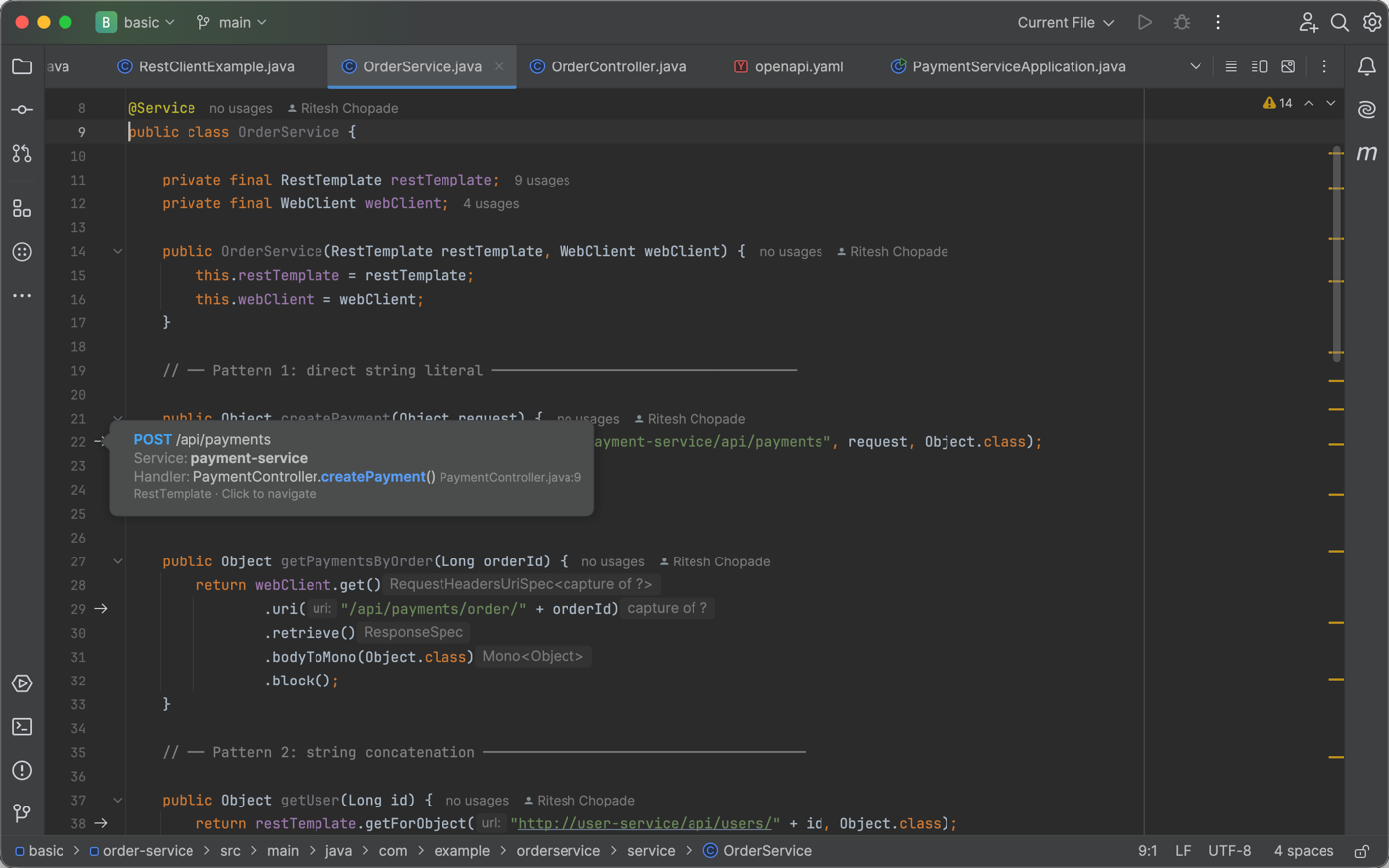
Spring Service Navigator maps every inter-service HTTP call in your Spring Boot workspace from source code alone, and lets you jump between callers and endpoints in one click. No running servers. No instrumentation. Free, and works in IntelliJ IDEA Community Edition.
SERVICE MAP — LIVE FROM SOURCE
Redrawn from your actual source — this is what the Service Map tool window shows, live.
FEATURED PROJECT
Spring Service Navigator
Every RestTemplate,
WebClient,
RestClient,
@FeignClient, and
@HttpExchange call site gets a gutter
icon that jumps straight to the target endpoint — even across modules, or across services
split into separate git repos. Every endpoint gets a reverse-navigation icon back, so you
can see the blast radius of a contract change before you make it.
WHAT IT DOES
Six ways it keeps you oriented
→ OUTBOUND
Caller → endpoint, one click
A gutter icon on every HTTP call site jumps straight to the matching controller method, even in a different module.
← INBOUND
Endpoint → every caller
Reverse-navigation icons on @RestController methods list every service that calls them, before you touch the contract.
MAP
Service Navigator tool window
Six tabs: Service Map, Endpoints, Statistics, Dependency Matrix, Unresolved Callers, and Dependency Graph.
RESOLVE
Smart URL resolution
Concatenation, String.format, UriComponentsBuilder, @Value/@ConfigurationProperties, ternaries, and reassigned variables — all resolved per call site.
REPOS
One workspace or many repos
Works whether services are modules in one build, content roots in one window, or opened in separate IntelliJ windows entirely.
STATIC
No runtime required
Built on JavaParser, reading .java source only. Nothing is compiled, instrumented, or executed.
UNDER THE HOOD
URLs built at runtime, resolved at scan time
Real call sites rarely use plain string literals. The resolver handles the patterns actual codebases use — including a variable reassigned between two different calls in the same method, resolved independently per call site.
LATEST RELEASE